Do you want to integrate high-quality literature in your science lessons? Do you need high-quality non-fiction books for Common Core ELA lessons? We know you don't have the time to locate these sources, so we'll hunt for great books, and showcase them here.
Showing posts with label seasons. Show all posts
Wednesday, May 8, 2013
Are trees alive?
The inspiration behind Debbie Miller's book Are Trees Alive? (2003) was that very question from her child. So often young children associate "living" with movement or with observable growth, neither of which a mature oak tree would display; in this case, her daughter thought that trees could not "breathe" because they did not have noses, and therefore were not living. The parallels between features of trees and features of humans - for example, how roots anchor the tree just like feet anchor us to the ground - make the scientific content relatable to primary-level children in a meaningful way. It's important for children to realize that just because trees don't "breathe" like humans doesn't mean they don't rely on oxygen! From a language arts standpoint, this book would be a great model for the "A is to B as X is to Y" kinds of comparisons. The end notes contain additional information about specific trees featured in the book, including the general geographic location of the species and scientific names.
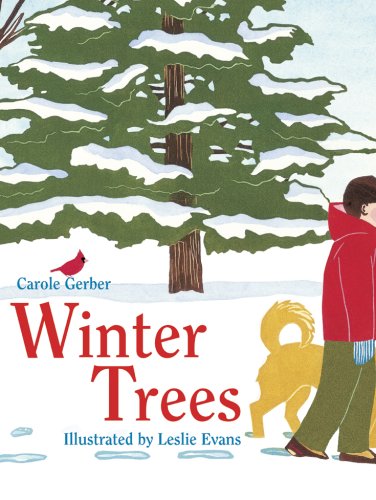
It's not winter, but keep this other award-winning book about trees in mind for next fall as the leaves begin to drop: Winter Trees by Carole Gerber (2008). We often consider tree identification through leaves and on what trees look like in the summer and fall seasons, full of green leaves or the hues of yellow and red as the days become shorter. This book is unique in its portrayal of the branching structures only observed in the winter when trees are without their leaves (although evergreens are also portrayed). Written in prose with limited text, this read-aloud book contains just enough information to convey the structural differences among oaks, beeches, and other types of trees. The illustrations by Leslie Evans are realistic enough for noting those differences, though not as detailed as those presented in books by Sill (such as About Habitats).
Tuesday, April 16, 2013
Meet Melissa Stewart!
With bumblebees buzzing around the budding trees, and frogs bellowing in the marshy bogs, it's easy to forget that we've neither heard nor seen certain animals all winter. Have you ever wondered where those bees and frogs have been? What about the ladybugs and snakes you might see around your house or in the nearby park?
Author Melissa Stewart, who presented with us at the recent NSTA conference, has an excellent book to engage students with thinking about where animals have been all winter. Under the Snow (2009) is just one of Melissa's 150 nonfiction books for children. The opening sentence of this book instantly creates an advanced organizer for the reader: "In the heart of winter, a deep layer of snow blankets fields and forests, ponds and wetlands." This "hidden world" under our feet and under the ice is captured by watercolor illustrations, with simple yet descriptive text about animals in each of these
four habitats.
A similarly styled book by Melissa is When Rain Falls (2008). In this book, animals in the forest, field, wetland and desert are portrayed as rain falls. We learn about the hawk, which "puffs out its feather to keep water out and warmth in," as well as ants, which "stay safe in their underground nests." Both of these book are definitely appropriate as read-alouds for primary students, and the beautiful watercolor illustrations can support new vocabulary such as "crevice."
Are you looking for a book to apply cause and effect? Try A Place for Birds (2009). This book provides age-appropriate descriptions of how human actions impact birds. For example, one page spread depicts the Eastern bluebirds, with sidebar text describing how nesting needs of these birds are adversely impacted by cutting down dead trees and replacing wooden fenceposts with metal ones. The main text reads: "Some birds can only build their nests in small hollow places. When people build nesting boxes that are the right size and shape, birds can live and grow." The text of each subsequent page spread continues with the pattern of "When people (engage in an action)... birds can live and grow."We love how positive solutions are presented in each scenario!
A final note is Melissa's blog, which focuses on nonfiction books for children, and her "Science Clubhouse" website, with links for kids, teachers, and librarians. Definitely check out her teacher resources on the clubhouse website, which include curriculum guides and Readers Theatre scripts! Melissa makes it easy to integrate science and literacy!
Author Melissa Stewart, who presented with us at the recent NSTA conference, has an excellent book to engage students with thinking about where animals have been all winter. Under the Snow (2009) is just one of Melissa's 150 nonfiction books for children. The opening sentence of this book instantly creates an advanced organizer for the reader: "In the heart of winter, a deep layer of snow blankets fields and forests, ponds and wetlands." This "hidden world" under our feet and under the ice is captured by watercolor illustrations, with simple yet descriptive text about animals in each of these four habitats.
A similarly styled book by Melissa is When Rain Falls (2008). In this book, animals in the forest, field, wetland and desert are portrayed as rain falls. We learn about the hawk, which "puffs out its feather to keep water out and warmth in," as well as ants, which "stay safe in their underground nests." Both of these book are definitely appropriate as read-alouds for primary students, and the beautiful watercolor illustrations can support new vocabulary such as "crevice."
Are you looking for a book to apply cause and effect? Try A Place for Birds (2009). This book provides age-appropriate descriptions of how human actions impact birds. For example, one page spread depicts the Eastern bluebirds, with sidebar text describing how nesting needs of these birds are adversely impacted by cutting down dead trees and replacing wooden fenceposts with metal ones. The main text reads: "Some birds can only build their nests in small hollow places. When people build nesting boxes that are the right size and shape, birds can live and grow." The text of each subsequent page spread continues with the pattern of "When people (engage in an action)... birds can live and grow."We love how positive solutions are presented in each scenario!A final note is Melissa's blog, which focuses on nonfiction books for children, and her "Science Clubhouse" website, with links for kids, teachers, and librarians. Definitely check out her teacher resources on the clubhouse website, which include curriculum guides and Readers Theatre scripts! Melissa makes it easy to integrate science and literacy!
Subscribe to:
Posts (Atom)