Showing posts with label Outstanding Science Trade Book. Show all posts

Wednesday, April 30, 2014

Behold the lowly tapir

Behold the lowly South American tapir. I only knew of it through my girls' (now in high school) alphabet card matching game of mothers and babies. A was for Anteater, B was for Bear...T was for Tapir, which I unknowingly pronounced as "tap--eer" all those years. It's actually "tape-ear." But then again, I say "draw" for drawer (it's a northern thing) and my Texan husband uses "pin" for both the sewing item and writing implement. He also uses "next week" for this week, but I digress. 

The tapir is the subject of an amazing scientist-in-action book called The tapir scientist: Saving South America's largest mammal by Sy Montgomery, with pictures by noted photographer Nic Bishop. Even the title of this book packs a punch:  you know the tapir is in danger, you know where it lives, you know something about its size, and you know what kind of animal it is. The title alone is a lesson in concise communication! As noted in the first chapter, fossils of the first tapirs are from about 12 million years ago during the Miocene era. Despite this long history, tapirs are little known. This animal needs a publicist, and Montgomery is the perfect person to raise awareness of this interesting mammal. 

This NSTA/CBC Outstanding Science Trade Book published in 2013 chronicles the work of Pati Medici and her team of field scientists as they track, observe, and monitor these clandestine creatures. Medici's work is not for the faint of heart or those who prefer hotels to camping (like myself): mosquitoes and ticks abound, pumas surround, sleep is minimal. I can hardly shoo kids out the door without morning coffee, so mustering early morning energy to gather scat - and being excited about it - is something I can only admire from afar. Several vignettes are also included, such as profiles of other team members and information about how scientific research is conducted. For example, "Pati's Spreadsheets" provides an explanation of how data collected in the field is analyzed. Nic Bishop's photos add to the high interest level of this book; whether he's capturing tapirs at night with infrared cameras or shooting up-close photos of gloved hands picking ticks off the tapir's back, Bishop's images bring this story to life. 

To accompany the print portion of Medici's field work, there are videos available from the Scientists in the Field website.  These would be great resources to share with students in addition to reading aloud portions of the text - for example, you can listen to an interview with Montgomery about her research for this book. The tapir is hardly the rockstar of the animal world, but this book will engage you with its fascinating story. 

Tuesday, September 17, 2013

Conquering Arachnophobia


Spiders, members of the arachnid class, can evoke both awe and fear. There is a reason that movies such as Arachnophobia are created – people relate to that fear of spiders. Had the producer tried to pitch Lepidoptera phobia (fear of butterflies and moths), I doubt it would have gone very far. The closest I can think of is Mothra, the low-budget sci-fi movie from 1961featuring a giant moth. 

For the past week, an industrious spider has maintained an elaborate orb web right outside our front door. My son first noticed it one morning as the web seemed to be floating in midair, easily visible with droplets of dew. As expected, he had a mixed reaction to seeing the spider - he did not want to get to close to it, but watched in amazement as it gingerly walked up and down the web. Seeing it outside was certainly preferable to finding one in the bathtub, which has also occurred recently.  Some studies suggest that you are never more than ten feet away from one, so whether you want to see spiders or want to avoid them, they are always nearby! Maybe that reminds you of some of your neighbors. 


 If you want to know more about spiders to demystify them, here are two suggestions. For intermediate students, Sandra Markle’s Sneaky, spinning baby spiders (2008) vividly depicts many aspects of these incredible arthropods. This book has been recognized as an NSTA/CBC Outstanding Science Trade Book and has earned other awards as well. Segments entitled “Starting life in an egg” and “Mom on guard” describe the life cycle of spiders, supported by large, up-close photos of various species. The end pages include a habitat map for each spider species depicted in the text, a “Be nice to spiders” segment that provides an overview of their importance in the ecosystem, and a combined glossary/index. Markle also includes a brief endnote about her inspiration for writing the book.


For younger students, it’s certainly easy to find books about the butterfly’s life cycle. Perhaps that’s because of its interesting stages and beautiful adult species. While many of us are familiar with Charlotte’s egg sack gallantly protected by Wilbur in E.B. White's Charlotte's web, there are limited options for informational texts about arachnid life cycles. One choice is Up, up, and away by Ginger Wadsworth (2009).  Also recognized by NSTA/CBC as an Outstanding Science Trade Book, this book depicts a spider’s life cycle with simple text appropriate for primary students. The life cycle of a spider is described through the four seasons, beginning with a spider forming an egg sack in the fall. Predatory/prey relationships are incorporated as the spiders encounter lizards, snakes, and birds. The illustrations are more accurate than cartoon depictions, but are not quite technical reproductions. An endnote entitled "The spin on garden spiders" describes the species from the book (Argiope aurantia) in greater detail. 
 

As a final note, you can participate in a citizen scientist documentation of wildlife in your area, including spiders, through Project Noah. Supported by National Geographic, this site contains photographs of local organisms taken by students and others who are interested in documenting plants and animals in their environment.  Strategies to help teachers incorporate science investigations in schoolyards and backyards can be found under the Education link. 

The more students know about spiders, the more likely they will be to recognize their importance in the ecosystem. As stated so beautifully by Marie Curie: "Nothing in life is to be feared, it is only to be understood. Now is the time to understand more, so that we may fear less."  

Wednesday, September 4, 2013

Chickens and Eggs

Last week (or a little longer), one of our readers asked for any books that might accompany the installation of a school chicken coop, so we've been doing a little digging. We haven't found a whole lot of what we would call high-quality picture books for kids that relate specifically to raising chickens, but chickens and eggs in general...well, we do have some suggestions for addressing those topics.

In the "Oldies but Goodies" category, we want to highlight two books in particular: Ruth Heller's Chickens Aren't the Only Ones and Chicken an Egg, by Christine Back & Jens Olesen. I'm going to date myself a bit by saying that I used both of these in my own 2nd grade classroom each spring when we studied oviparous animals ...and hatched chickens with the support of our local agricultural  extension (who provided the incubators and eggs!).

My favorite for showing the development of a chicken was Chicken and Egg, with its full-color photographs and two layers of text. It appears to be out of print, but  is available in paperback through a number of venues (including Amazon, linked above). Chicks & Chickens, by Gail Gibbons and From Egg to Chicken, by Anita Ganeri are newer (2005 & 2006, respectively) and also offer insights on chicken development. These two  include a great deal of extra information on chickens in general. Chicks & Chickens addresses their physical characteristics and behavior in addition to their life cycle and egg development. In this book, Gibbons follows her typical style of including a lot of information supported by detailed illustrations in bold colors that tend to extend the text though the use of diagrams. From Egg to Chicken is a more traditional non-narrative informational text, including a table of contents, bolded key words, a glossary, suggested resources, and even an index. It would engage kids through the vivid photographs of chickens and the accompanying captions. Both Chicken and Egg and Egg to Chicken could be used with younger students, and while the book by Gibbons could be read aloud to just about anyone, the text is probably most appropriate for 3rd graders. 


Chickens Aren't the Only Ones appears to remain a popular despite its age. It, however, goes beyond chickens to mention all sorts of animals that lay eggs. Birds, reptiles, amphibians, and fish...snails, spiders, and all sorts of insects are addressed, though not in any detail, making it a great introduction to the concept of oviparous animals. Another great addition to a lesson on egg-layers is a 2007 NSTA Oustanding Science Trade Book winner, Guess What is Growing Inside this Egg, by Mia Posada. This book is illustrated so that the reader gets clues (in verse) about the kind of animal growing in the egg, and when the page is turned, the full illustration reveals the animal, accompanied by a detailed description (not in verse) about the newly hatched animal. An Egg is Quiet, by Dianna Aston would be a great companion book to use with Guess What's Growing Inside this Egg, though Aston's book focuses just on the eggs themselves. The only tricky part of An Egg is Quiet is that its primary layer of text is written in cursive, making it tough for kids to read independently. However, the illustrations are all labeled in more typical printed text, and so a lot of information can be gleaned without paying attention to the lines written in script. Aston compares the shape, size, colors, texture, and markings of eggs, and takes a page or two to highlight the in-egg development of chickens, salmon, and grasshoppers. Sylvia Long's stunning illustrations make this book a work of art as well as a means of obtaining both textual and visual information.


Finally, I couldn't let the chicken and egg topic go without mentioning One Hen: How one Small Loan Made a Big Difference, by Katie Smith Milway. This book is geared a little more toward social studies in general and economics in particular. But, it tells the story of Kojo, a youngster living in the Ashanti region of Ghana, in Africa, and how he uses a few coins to buy a hen...and then sells the extra eggs at market...and then buys more hens...and then a farm (after he goes to school of course!)...and eventually chages the lives of his family, community, and town. Best of all, it's based on the true story of Kwabena Darko; check out this related video on YouTube!


Wednesday, May 8, 2013

Are trees alive?

"Are trees alive?" 

The inspiration behind Debbie Miller's book Are Trees Alive(2003) was that very question from her child. So often young children associate "living" with movement or with observable growth, neither of which a mature oak tree would display; in this case, her daughter thought that trees could not "breathe" because they did not have noses, and therefore were not living. The parallels between features of trees and features of humans - for example, how roots anchor the tree just like feet anchor us to the ground - make the scientific content relatable to primary-level children in a meaningful way. It's important for children to realize that just because trees don't "breathe" like humans doesn't mean they don't rely on oxygen! From a language arts standpoint, this book would be a great model for the "A is to B as X is to Y" kinds of comparisons. The end notes contain additional information about specific trees featured in the book, including the general geographic location of the species and scientific names.


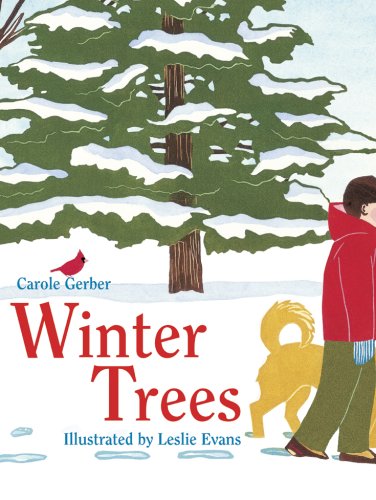
It's not winter, but keep this other award-winning book about trees in mind for next fall as the leaves begin to drop: Winter Trees by Carole Gerber (2008). We often consider tree identification through leaves and on what trees look like in the summer and fall seasons, full of green leaves or the hues of yellow and red as the days become shorter. This book is unique in its portrayal of the branching structures only observed in the winter when trees are without their leaves (although evergreens are also portrayed). Written in prose with limited text, this read-aloud book contains just enough information to convey the structural differences among oaks, beeches, and other types of trees. The illustrations by Leslie Evans are realistic enough for noting those differences, though not as detailed as those presented in books by Sill (such as About Habitats).