Showing posts with label elementary science. Show all posts

Tuesday, January 21, 2014

What a Winter!

Clearly, the end of 2013 was a busy one for Kristin and me, and this blog took a back seat to the other 3,427 things we had to get done. But we're well into 2014, and we're ready to get back to our regular entries!

So far, most of the country has experienced quite a winter. Meteorological terms like "polar vortex" have been the topic of conversation (Go, Al Roker!), and another big snowstorm is hitting the East Coast. Temperatures have been dropping here in Knoxville all day, and earlier in the day I got stuck in a downpour consisting of what appeared to be tiny snowballs (no flakes!) that stuck to everything (including hair) and took their own sweet time to melt. With that experience fresh on my mind, I headed to my bookshelf to pull out some "snow" books--to see how those crystals might have formed (I think they might have been classified as "lump graupel" according to Magono & Lee's snow crystal classification system). And while I was at it, I grabbed a few others that might be appropriate for the coming chilly week.


The first is appropriately titled, The Story of Snow: The Science of Winter's Wonder, by Mark Cassino. It has multiple layers of text, diagrams, and photographs, making it engaging for a wide range of readers and grade levels. The scientific vocabulary included isn't overwhelming because the explanations are straightforward, and the diagrams help to provide context--especially in terms of "book" vs. "real life" size comparisons (see below).  Directions for catching your own snowflakes are included, as well. This 2010 Outstanding Science Trade Book Award winner should be a staple in elementary classrooms.

"Snowflake" Bentley and his camera.
The perfect book to accompany The Story of Snow, is the oldie but goodie, Snowflake Bentley, by Jaqueline Briggs. This 15-year-old is now almost a "classic," and is Bentley's story is just as intriguing now as it was in 1998. Teachers now also have access to a great Wilson Bentley website run by the Jericho, VT (his hometown) Historical Society. They have resources that include his biography, photos, articles, book reviews, and even some FAQs. The website makes a nice companion to the book, and Scholastic (or Amazon) now offers some of Bentley's books: Snowflakes in Photographs and Snow Crystals.


Finally,  I was really excited when I ran across this book cross-listed on Amazon, since it seems to be written for a similar elementary crowd by a current "Snowflake Bentley" type! The Secret Life of a Snowflake: An Up-Close Look at the Art and Science of Snowflakes, is full of photos and explanations at just the right level for elementary students. It is written by Dr. Kenneth Libbrecht, a physicist and professor at CalTech. (He grew up in North Dakota, so he knows his snow!), who has his own website full of great teaching resources. This book will be most appreciated by upper elementary (and middle school) students, but the photos (like the one below, comparing snowflake sizes to a penny) look engaging for all ages! This is one I'm going to order so that in the future, it sits side-by-side with the others on my shelf!


Monday, September 30, 2013

'Tis the Season for Skeletons

At my daughter's request, this was the weekend of getting the pumpkins, spiders, ghosts, and skeletons out of the plastic crates where they reside and scattering them around the house Her favorite is always the peel-and-stick glow-in-the-dark skeleton that typically spends the  month of October in the middle of our powder room mirror. (Yes--it takes maneuvering to actually use the mirror, but all three kids say, "We have to put the skeleton there...It's tradition!") The combination of the skeleton staring me in the face every time I wash my hands and the release of Cut to the Bone, the newest book written by UT's renowned forensic anthropologist, Dr. Bill Bass, and his writing partner, Jon Jefferson (I got my signed copy Saturday!) made me decide skeletons & bones would be the topic of choice for this week's blog. 

One of our favorite skeleton books is, You Can't See Your Bones with Binoculars, by Harriet Ziefert. Each page (or 2-page spread) is headed by a slightly-adapted line from the African American spiritual Dry Bones ("The foot bones are connected to the toe bones..." and the playful illustrations integrate actual x-rays as a means of showing the bones in their proper place and form. The text contains information about key bones, including their general ("shoulder") and more technical ("clavicle" and "scapula") terms, in addition to a description of their purpose ("...the main task of the backbone is to protect your spinal cord.") or how they function ("The 'ball' at the top of another bone called the humerus rotates so that you can move your arm in all directions!). Most two page spreads also contain an interesting fact or two related to the bone being discussed--like people who wear knee pads since kneecaps don't have much padding. The book draws to a close with a solid page of information about broken bones and a drawing of a skeleton with all the previously mentioned bones clearly labeled. This book makes a perfect read-aloud for 2nd grade and up, but 4th and 5th graders will also enjoy reading this non-fiction text independently.

Bob Barner has another skeleton book, straightforwardly called Dem Bones. It, too, includes a line from the traditional song on each page, supported by a short, 3-4 sentence paragraph with details about the identified bone. For example, on the "leg bone" page, Barner delineates that the leg bone is actually two bones and the location of each, along with a note that it is the tibia that hurts if you get kicked in the shin! These big bold illustrations are actually of whimsical skeletons and not as clearly marked as those in Zeifert's book. However, this one too, closes with a labeled skeleton, and the more compact nature of the text makes it  more appropriate for a K-1 read aloud, and the less technical language makes it a more independent read for those in 2nd grade and up. (And, there is a YouTube video reading of this book done by some college students that could be used in a listening center!)

October is the perfect time to use easy access to skeletons of all sorts to your students' learning advantage! If you really want to help them learn the bone-associated vocabulary, make it interactive. Buy a cardboard skeleton, and use adhesive Velcro dots to attach labels. The kids should be able to pull all the labels off and then show what they know!

Tuesday, September 17, 2013

Conquering Arachnophobia


Spiders, members of the arachnid class, can evoke both awe and fear. There is a reason that movies such as Arachnophobia are created – people relate to that fear of spiders. Had the producer tried to pitch Lepidoptera phobia (fear of butterflies and moths), I doubt it would have gone very far. The closest I can think of is Mothra, the low-budget sci-fi movie from 1961featuring a giant moth. 

For the past week, an industrious spider has maintained an elaborate orb web right outside our front door. My son first noticed it one morning as the web seemed to be floating in midair, easily visible with droplets of dew. As expected, he had a mixed reaction to seeing the spider - he did not want to get to close to it, but watched in amazement as it gingerly walked up and down the web. Seeing it outside was certainly preferable to finding one in the bathtub, which has also occurred recently.  Some studies suggest that you are never more than ten feet away from one, so whether you want to see spiders or want to avoid them, they are always nearby! Maybe that reminds you of some of your neighbors. 


 If you want to know more about spiders to demystify them, here are two suggestions. For intermediate students, Sandra Markle’s Sneaky, spinning baby spiders (2008) vividly depicts many aspects of these incredible arthropods. This book has been recognized as an NSTA/CBC Outstanding Science Trade Book and has earned other awards as well. Segments entitled “Starting life in an egg” and “Mom on guard” describe the life cycle of spiders, supported by large, up-close photos of various species. The end pages include a habitat map for each spider species depicted in the text, a “Be nice to spiders” segment that provides an overview of their importance in the ecosystem, and a combined glossary/index. Markle also includes a brief endnote about her inspiration for writing the book.


For younger students, it’s certainly easy to find books about the butterfly’s life cycle. Perhaps that’s because of its interesting stages and beautiful adult species. While many of us are familiar with Charlotte’s egg sack gallantly protected by Wilbur in E.B. White's Charlotte's web, there are limited options for informational texts about arachnid life cycles. One choice is Up, up, and away by Ginger Wadsworth (2009).  Also recognized by NSTA/CBC as an Outstanding Science Trade Book, this book depicts a spider’s life cycle with simple text appropriate for primary students. The life cycle of a spider is described through the four seasons, beginning with a spider forming an egg sack in the fall. Predatory/prey relationships are incorporated as the spiders encounter lizards, snakes, and birds. The illustrations are more accurate than cartoon depictions, but are not quite technical reproductions. An endnote entitled "The spin on garden spiders" describes the species from the book (Argiope aurantia) in greater detail. 
 

As a final note, you can participate in a citizen scientist documentation of wildlife in your area, including spiders, through Project Noah. Supported by National Geographic, this site contains photographs of local organisms taken by students and others who are interested in documenting plants and animals in their environment.  Strategies to help teachers incorporate science investigations in schoolyards and backyards can be found under the Education link. 

The more students know about spiders, the more likely they will be to recognize their importance in the ecosystem. As stated so beautifully by Marie Curie: "Nothing in life is to be feared, it is only to be understood. Now is the time to understand more, so that we may fear less."  

Thursday, August 22, 2013

The Start of School - Nothing to Sneeze At

Even though it's not yet Labor Day - the signature date for the end of summer in many areas - teachers are two weeks into the school year here in Knoxville. It's back to basking in the glow of fluorescent lights after soaking up extensive amounts of Vitamin D while reading a novel on your back porch or watching grass grow from the bleachers of the T-ball field this summer. The start of school brings visions of classrooms stocked with pencils, glue sticks, new crayons, and hopefully a case of tissues. Yes, it's that time of year when you have to rebuild your germ immunity that may have lapsed over the summer.

Fighting off those ever-present germs in a classroom is nothing to sneeze at (for a brief history of that phrase, check out this explanation). If you want to learn more about sneezing, here is an excellent resource:  Sneeze, by Alexandra Siy and Dennis Kunkel (2007).  Alexandra is an outstanding science trade book author, and I guarantee that kids will love this book! It has the "wow" factor from the full page scanning electron microscope images of items that cause you to sneeze (mites, house dust, goose down, influenza virus) as well as the parts of you involved in sneezing (bronchial tube, skeletal muscle). The images are paired with simple text and pictures of kids sneezing and engaging in activities leading to sneezing (looking for their cat under the couch). So clever! A glossary and information about the book images completes this resource.

As long as we're on the topic of body invaders, I'll include a second one that has perhaps a little more of the ick-factor as far as my kids were concerned: What's eating you? Parasites - The inside story by Nicola Davies (2007). The cartoon-style illustrations do include talking tapeworms and bike-riding fleas, but the text is scientifically accurate (as well as extremely interesting). You may not encounter fleas or tapeworms at your school, but you are most likely already a host for harmless hair mites, and many schools have head lice checks --- it's just science in your everyday life! This book presents information about both harmful and harmless parasitic organisms in a non-threatening (and not overly grotesque) manner, and along the way, contextualizes terms such as habitat, ectoparasite, and endoparasite.

Best wishes for a healthy school year!

Friday, July 19, 2013

Flower Hunting


When we first moved to our home, our girls said it reminded them of Luna Lovegood's house. Not that we live in a giant rock-shaped castle, but more along the line that we had primarily monochromatic shrubs surrounding the perimeter, including a large one with particularly knobby branches that bend and twist in a style that reminds one of gnarled hands. Even the unidentified tree on the side of the driveway propagates with airy tufts of brown fuzz that stick (unfortunately) in our neighbor's fence. So we started to plant flowers - familiar ones, at that - to brighten the yard. Purchasing flowers reminded me of how little I know about botany, unlike the early settlers who relied so heavily on that practical knowledge for survival.


An outstanding resource for demonstrating the importance of botanical knowledge in colonial times is Deborah Kogan Ray's 2004 book entitled The Flower Hunter: William Bartram, American's First Naturalist.  Recognized by NSTA/CBC as an Outstanding Science Trade Book, this book eloquently presents the life of William Bartram through diary-style entries, beginning with one from his Pennsylvania farm on his 8th birthday in 1747. Bartram's father was a botanist for the king of England, sending seeds back to England from trees in their area, and taught young William to make careful observations of plants. They travelled as far south as Florida and as far west as the Mississippi River, identifying and drawings species. Accounts of William's travels and discoveries (and the French and Indian War), written as if he were authoring the journal entries, are supported with full-page watercolor illustrations. My favorite is an original full-page engraving of a plant he named in honor of his hero, Benjamin Franklin: Franklinia alatamaha. Brief biographies of William and his father are included at the end, along with a full page of the plants they identified and named. In the author's note, Ray includes information about the spellings of places that differed from Bartram's original writings.


An accompanying book that engages children with the flowers in their world is one I happened to find recently at the Knox County library. Ellen B. Senisi's Berry Smudges and Leaf Prints: Finding and Making Colors from Nature describes how to use plants and fruits to make unique art as well as the science behind that art. So many interesting aspects of color are included in this book: historical (the value of purple dye), feelings ('the blues'), and of course scientific (green as camouflage). Each profiled color is described with about three short paragraphs of these aspects, followed by nature-based projects  (leaf prints and spinach ink for green, for example, or pressed flower bookmarks from violets). Making dyes by heating, soaking or from "straight" (as is) plant materials are included. The book ends with full-page spreads of the history of color and additional science facts in a question/answer form ("Why is the sky blue?").

Considering again how reliant people were on their natural surroundings just a few generations ago, both of these books can be used to inform students about both the aesthetic and utilitarian value of plants.


Wednesday, June 26, 2013

Roebling and Grandin: Extraordinary Engineers

You may have never heard either of those two engineers, but I bet you are familiar with the work of at least one of them. John Augustus Roebling was the mastermind behind the design of the Brooklyn Bridge. Arriving at age 25 from Germany, John began drafting the bridge design and proposal in 1867 as a way to connect Manhattan to Brooklyn. His son, Washington, took the lead after John tragically died right after construction started. The bridge opened with enormous fanfare in 1883.

As told by Lynn Curlee in Brooklyn Bridge (2001), the engineering challenges posed during this nearly 25 year project were unprecedented. Full page paintings depict the inner workings of the structural design, such as the caissons used for allowing the workers to dig under the river (initially by hand, mostly by Irish immigrants). This is definitely an upper elementary book with some technical information interspersed during the human drama of the construction, but it is very readable and engaging. At only 35 pages long with full page illustrations, it's an informative narrative about a fascinating project.

End pages include a full spread labeled drawing of the Brooklyn Bridge, and during/after depictions of the suspension component of the bridge. A page is devoted to the specification for those who love numbers, and a timeline is also included.

And now for the second engineer for this blog, Temple Grandin. Sy Montgomery's 2012 book about her life is nothing short of amazing. How had I never heard of this person??!! Pick up Temple Grandin: How the Girl who Loved Cows Embraced Autism and Changed the World. I guarantee you will be inspired!

As the title indicates, Temple was diagnosed with autism as an young girl. The first chapter of 13 provides background on Temple's early years during which she struggled with sensory overload. As the title "Senses on fire" suggests, sounds and sights that would not be noticed by most kids were overwhelming to her. After struggling for years in school, her mother sought a high school that allowed her to flourish, and she went on to pursue a master's degree and eventually a Ph.D. in animal science. She looked at problems differently from others -- from the perspective of the livestock -- and revolutionized the designs of cattle chutes, dip vats, and slaughterhouses.  This, from a girl whom many considered unable to be educated!

Photos and design schematics complement the text, and the schematics show the marvels of engineering. An appendix entitled "Temple's advice for kids on the spectrum" contains her seven suggestions for kids with autism. Suggested books, articles and websites are also included. So whether you are seeking an upper intermediate or middle school book to depict engineering applications, promote understanding and tolerance, or provide a glimpse into the life of someone with autism, the story of Temple will not disappoint you.

Tuesday, May 21, 2013

A dog named Newton helps explain physics!

Finding high-quality trade books about animals, plants, space and weather can take time, but the task of locating a physical science trade book appropriate for primary grades is definitely daunting. One book we've found is Newton and Me by Lynne Mayer. Published by Sylvan Dell and recognized as an NSTA Outstanding Science Trade Book, this book shows applications of Isaac Newton's first and second laws of motion in contexts familiar to kids - pushing a ball and pulling a wagon, for example. The story of a boy and his dog, Newton, is told in prose with limited text on each page. Cartoonish drawings support the text and sometimes contain embedded content -  the name of the street where the boy lives (Lincolnshire) is Newton's birthplace in England. Like all Sylvan Dell books (see our previous blog about this publisher), there is a "For Creative Minds" section at the end. This section includes questions/answers about the content, a brief biography of Newton, and a matching game.


If you want a little background information in physics, or have a highly  inquisitive upper intermediate student, one suggestion is to keep Physics: Why Matter Matters! on hand. Written by Dan Green and illustrated by Simon Basher, this 2008 book is one of many in the Basher science series published by Kingfisher. The format of each page is the same: one page of text written in first person, and a full-page cartoon drawing of the concept personified. For example, "Acceleration" is depicted as a little face in a rocket, accompanied by the following text: "Forget the need for speed - I've got what it takes to get you going. I'm what makes things pull away from one another, like cars at a traffic light... To fire me up, forces have to be unbalanced, and I always zip off in the direction of the bigger force..." Fun facts are included in smaller font at the bottom of the page; in this case, we learn the acceleration of a cheetah (144 m/s2) and person associated with its discovery  (Benedetti in 1553). Topics include motion, light, sound, waves, electricity, and nuclear energy. Students - or teachers! -  with those beyond-the-elementary-textbook questions (What is a vacuum in space? How do magnets work?) would benefit from this book's easy-to-read format.

Wednesday, May 8, 2013

Are trees alive?

"Are trees alive?" 

The inspiration behind Debbie Miller's book Are Trees Alive(2003) was that very question from her child. So often young children associate "living" with movement or with observable growth, neither of which a mature oak tree would display; in this case, her daughter thought that trees could not "breathe" because they did not have noses, and therefore were not living. The parallels between features of trees and features of humans - for example, how roots anchor the tree just like feet anchor us to the ground - make the scientific content relatable to primary-level children in a meaningful way. It's important for children to realize that just because trees don't "breathe" like humans doesn't mean they don't rely on oxygen! From a language arts standpoint, this book would be a great model for the "A is to B as X is to Y" kinds of comparisons. The end notes contain additional information about specific trees featured in the book, including the general geographic location of the species and scientific names.


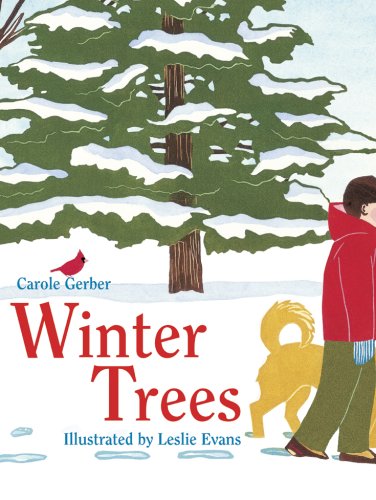
It's not winter, but keep this other award-winning book about trees in mind for next fall as the leaves begin to drop: Winter Trees by Carole Gerber (2008). We often consider tree identification through leaves and on what trees look like in the summer and fall seasons, full of green leaves or the hues of yellow and red as the days become shorter. This book is unique in its portrayal of the branching structures only observed in the winter when trees are without their leaves (although evergreens are also portrayed). Written in prose with limited text, this read-aloud book contains just enough information to convey the structural differences among oaks, beeches, and other types of trees. The illustrations by Leslie Evans are realistic enough for noting those differences, though not as detailed as those presented in books by Sill (such as About Habitats).