Showing posts with label children's books. Show all posts

Monday, January 27, 2014

Beyond a shadow of a doubt, I'd like a spring forecast

This polar vortex phenomenon is getting a little old. The week ahead here in Knoxville includes below-freezing temperatures and some six-sided precipitation. However, we're in luck, possibly: February 2nd is approaching, the day when the world (or at least the US) eagerly awaits the long-term forecast by that cute meteorologist, Punxsutawney Phil. He even has his own website now, complete with some teacher resources (not much in the way of science, though). Having graduated from the University of Dallas where Groundhog Day is fanatically celebrated by students and alumni across the country, I can hardly wait to make a toast to Phil and cheer for the weather forecast he'll provide at 7:25 am on Sunday, especially if he does not see his shadow.

If you are looking for some resources to prepare for Groundhog Day, here are some ideas. A narrative non-fiction resource is Gail Gibbon's 2007 book Groundhog Day! In addition to the historical background about Groundhog Day, Gibbons' book also includes information about the physical attributes and burrow formations of groundhogs. The final page of this primary level book is entitled "Digging up groundhog facts"and contains additional interesting information. Cartoonish drawings of humans are coupled with some more realistic depictions of groundhogs, though still with an impressionistic aspect. You can download a teacher resource book for Gail Gibbons' books here.

Another choice for sharing the fun and science of groundhogs and weather predictions is Groundhog Weather School by Joan Holub. You might recognize her name from our blog post about cloud books - she is one of the authors of The Man Who Named the Clouds. If you have an older version of this book, the cover will be different - it was reprinted in 2013.  This book has a mix of story elements and factual information, making it both entertaining and informative. I am not usually an advocate of books with talking animals, but in this case, there are enough non-fiction aspects to make it worth including in a science/literacy lesson. A checklist of characteristics (such as mammal, live in burrow, rodent, herbivore) determines who gets into Groundhog Weather School, and other organisms which exhibit weather-related behavior such as honey bees and cows are described. Brief depictions of famous scientists associated with weather (such as Luke Howard  and Snowflake Bentley) are profiled. Due to the cartoon-style bubbles of text from the characters, this may be better as an independent read as opposed to a read-aloud, though you could certainly channel your inner Hollywood star to read in different voices. The final page includes historical information about Groundhog Day and a labeled drawing of a groundhog.

For science activities related to measuring shadows, you can find ideas from Scholastic  and Exploratorium. For a long-term project, consider having students measure their shadows once a week in the same spot around the same time from now until the end of the school year. They can graph the data to infer what causes the differences in the weekly measurements.

Whether you spend February 2nd watching Bill Murray in Groundhog Day, watching the Super Bowl or Puppy Bowl, or celebrating Groundhog Day with friends, we hope you enjoy this weather-based holiday!

Tuesday, January 21, 2014

What a Winter!

Clearly, the end of 2013 was a busy one for Kristin and me, and this blog took a back seat to the other 3,427 things we had to get done. But we're well into 2014, and we're ready to get back to our regular entries!

So far, most of the country has experienced quite a winter. Meteorological terms like "polar vortex" have been the topic of conversation (Go, Al Roker!), and another big snowstorm is hitting the East Coast. Temperatures have been dropping here in Knoxville all day, and earlier in the day I got stuck in a downpour consisting of what appeared to be tiny snowballs (no flakes!) that stuck to everything (including hair) and took their own sweet time to melt. With that experience fresh on my mind, I headed to my bookshelf to pull out some "snow" books--to see how those crystals might have formed (I think they might have been classified as "lump graupel" according to Magono & Lee's snow crystal classification system). And while I was at it, I grabbed a few others that might be appropriate for the coming chilly week.


The first is appropriately titled, The Story of Snow: The Science of Winter's Wonder, by Mark Cassino. It has multiple layers of text, diagrams, and photographs, making it engaging for a wide range of readers and grade levels. The scientific vocabulary included isn't overwhelming because the explanations are straightforward, and the diagrams help to provide context--especially in terms of "book" vs. "real life" size comparisons (see below).  Directions for catching your own snowflakes are included, as well. This 2010 Outstanding Science Trade Book Award winner should be a staple in elementary classrooms.

"Snowflake" Bentley and his camera.
The perfect book to accompany The Story of Snow, is the oldie but goodie, Snowflake Bentley, by Jaqueline Briggs. This 15-year-old is now almost a "classic," and is Bentley's story is just as intriguing now as it was in 1998. Teachers now also have access to a great Wilson Bentley website run by the Jericho, VT (his hometown) Historical Society. They have resources that include his biography, photos, articles, book reviews, and even some FAQs. The website makes a nice companion to the book, and Scholastic (or Amazon) now offers some of Bentley's books: Snowflakes in Photographs and Snow Crystals.


Finally,  I was really excited when I ran across this book cross-listed on Amazon, since it seems to be written for a similar elementary crowd by a current "Snowflake Bentley" type! The Secret Life of a Snowflake: An Up-Close Look at the Art and Science of Snowflakes, is full of photos and explanations at just the right level for elementary students. It is written by Dr. Kenneth Libbrecht, a physicist and professor at CalTech. (He grew up in North Dakota, so he knows his snow!), who has his own website full of great teaching resources. This book will be most appreciated by upper elementary (and middle school) students, but the photos (like the one below, comparing snowflake sizes to a penny) look engaging for all ages! This is one I'm going to order so that in the future, it sits side-by-side with the others on my shelf!


Tuesday, October 15, 2013

Carve out time to learn about pumpkins


We’ve been highlighting books on spiders and skeletons, so this post will continue the autumn theme by highlighting a few books about pumpkins. After all, what's a Halloween display without a glowing pumpkin to greet trick-or-treaters? Sure, there's sticky goo that has to be scooped out before etching triangle eyes and a toothy grin, but it beats trying to find an extension cord to plug in a synthetic jack-o-lantern. 

Gail Gibbons provides a classic book for this topic with The pumpkin book. Recognized by the International Reading Association as one of its Teachers' Choices for 2000, this book continues to be a great resource for both scientific and cultural information about pumpkins. The life cycle of the pumpkin is depicted through text as well as cartoon-style (but labeled) drawings. Connections with Halloween and Thanksgiving are included in the narrative, including a drawing of that quintessential carved pumpkin. The final page has short excerpts about historical, scientific, and cultural aspects of pumpkins, as well as directions for drying pumpkin seeds.


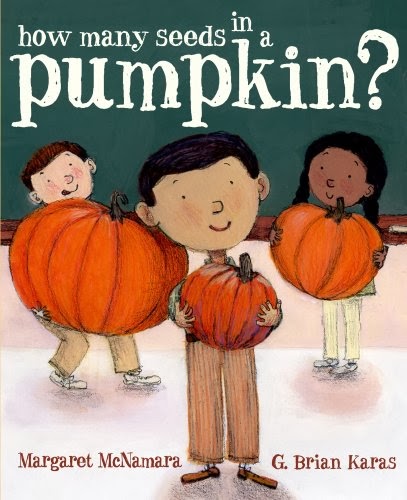
Speaking of seeds, a good read-aloud story about pumpkin seeds is Margaret McNamara’s How many seeds in a pumpkin? This 2007 fictional book, also recognized as a Teachers' Choices selection, tells the story of students in a first grade classroom who are predicting the number of seeds in small, medium, and large pumpkins. The students scoop out the seeds and count them by grouping in twos, fives, and tens, which makes this book a resource for easily integrating math with science. After all the seeds have been counted, the teacher explains some clues that his students can use for predicting the number of seeds, such as the color, species, and number of lines, indicating that it’s not just the size  of the pumpkin alone. Spoiler alert: The smallest pumpkin winds up having the most seeds. “Charlie’s Pumpkin Facts” at the end includes some facts about pumpkins, such as the time needed to progress from seed to fruit.

Finally, Pick, pull, snap! Where once a flower bloomed by Lola M. Shaeffer (2003) is a lift-a-flap book that overtly makes the connection between flowers and fruit. The writing style of this book is vivid and succinct, resulting in its recognition by the National Council of Teachers of English as a Notable Children's Book in the Language Arts. Each page spread has three to five richly descriptive sentences about one type of flower (“On a sandy hill, yellow blossoms open on knee-high plants, spilling soft pollen between petals”). The subsequent fruit is shown under the flap, like a mystery unveiled, and the text for each identified fruit ends with “… where a flower once bloomed.” Up-close paintings accurately portray the seeds and flowers, and children are depicted picking each resulting fruit: pea pods, raspberries, corn, peaches, peanuts, and pumpkins. The end pages include additional information about each fruit shown in the book as well as factual information about plant pollination and fertilization. A glossary includes words that are in the text of the book, such as “pollen,” and words that are in the end pages about plant fertilization, such as “anther” and “stamen.”

These are just some of the resources available for finding out about the life cycle of the pumpkin. Knowing about their life cycles may help you appreciate those slimy seeds and strings when you are carving! I'll have one carved with triangle eyes, but if you are the Martha Stewart type and want something more creative, you can check out her templates here.  

Monday, September 30, 2013

'Tis the Season for Skeletons

At my daughter's request, this was the weekend of getting the pumpkins, spiders, ghosts, and skeletons out of the plastic crates where they reside and scattering them around the house Her favorite is always the peel-and-stick glow-in-the-dark skeleton that typically spends the  month of October in the middle of our powder room mirror. (Yes--it takes maneuvering to actually use the mirror, but all three kids say, "We have to put the skeleton there...It's tradition!") The combination of the skeleton staring me in the face every time I wash my hands and the release of Cut to the Bone, the newest book written by UT's renowned forensic anthropologist, Dr. Bill Bass, and his writing partner, Jon Jefferson (I got my signed copy Saturday!) made me decide skeletons & bones would be the topic of choice for this week's blog. 

One of our favorite skeleton books is, You Can't See Your Bones with Binoculars, by Harriet Ziefert. Each page (or 2-page spread) is headed by a slightly-adapted line from the African American spiritual Dry Bones ("The foot bones are connected to the toe bones..." and the playful illustrations integrate actual x-rays as a means of showing the bones in their proper place and form. The text contains information about key bones, including their general ("shoulder") and more technical ("clavicle" and "scapula") terms, in addition to a description of their purpose ("...the main task of the backbone is to protect your spinal cord.") or how they function ("The 'ball' at the top of another bone called the humerus rotates so that you can move your arm in all directions!). Most two page spreads also contain an interesting fact or two related to the bone being discussed--like people who wear knee pads since kneecaps don't have much padding. The book draws to a close with a solid page of information about broken bones and a drawing of a skeleton with all the previously mentioned bones clearly labeled. This book makes a perfect read-aloud for 2nd grade and up, but 4th and 5th graders will also enjoy reading this non-fiction text independently.

Bob Barner has another skeleton book, straightforwardly called Dem Bones. It, too, includes a line from the traditional song on each page, supported by a short, 3-4 sentence paragraph with details about the identified bone. For example, on the "leg bone" page, Barner delineates that the leg bone is actually two bones and the location of each, along with a note that it is the tibia that hurts if you get kicked in the shin! These big bold illustrations are actually of whimsical skeletons and not as clearly marked as those in Zeifert's book. However, this one too, closes with a labeled skeleton, and the more compact nature of the text makes it  more appropriate for a K-1 read aloud, and the less technical language makes it a more independent read for those in 2nd grade and up. (And, there is a YouTube video reading of this book done by some college students that could be used in a listening center!)

October is the perfect time to use easy access to skeletons of all sorts to your students' learning advantage! If you really want to help them learn the bone-associated vocabulary, make it interactive. Buy a cardboard skeleton, and use adhesive Velcro dots to attach labels. The kids should be able to pull all the labels off and then show what they know!

Thursday, August 22, 2013

The Start of School - Nothing to Sneeze At

Even though it's not yet Labor Day - the signature date for the end of summer in many areas - teachers are two weeks into the school year here in Knoxville. It's back to basking in the glow of fluorescent lights after soaking up extensive amounts of Vitamin D while reading a novel on your back porch or watching grass grow from the bleachers of the T-ball field this summer. The start of school brings visions of classrooms stocked with pencils, glue sticks, new crayons, and hopefully a case of tissues. Yes, it's that time of year when you have to rebuild your germ immunity that may have lapsed over the summer.

Fighting off those ever-present germs in a classroom is nothing to sneeze at (for a brief history of that phrase, check out this explanation). If you want to learn more about sneezing, here is an excellent resource:  Sneeze, by Alexandra Siy and Dennis Kunkel (2007).  Alexandra is an outstanding science trade book author, and I guarantee that kids will love this book! It has the "wow" factor from the full page scanning electron microscope images of items that cause you to sneeze (mites, house dust, goose down, influenza virus) as well as the parts of you involved in sneezing (bronchial tube, skeletal muscle). The images are paired with simple text and pictures of kids sneezing and engaging in activities leading to sneezing (looking for their cat under the couch). So clever! A glossary and information about the book images completes this resource.

As long as we're on the topic of body invaders, I'll include a second one that has perhaps a little more of the ick-factor as far as my kids were concerned: What's eating you? Parasites - The inside story by Nicola Davies (2007). The cartoon-style illustrations do include talking tapeworms and bike-riding fleas, but the text is scientifically accurate (as well as extremely interesting). You may not encounter fleas or tapeworms at your school, but you are most likely already a host for harmless hair mites, and many schools have head lice checks --- it's just science in your everyday life! This book presents information about both harmful and harmless parasitic organisms in a non-threatening (and not overly grotesque) manner, and along the way, contextualizes terms such as habitat, ectoparasite, and endoparasite.

Best wishes for a healthy school year!

Tuesday, June 18, 2013

Gardening, Part 2

So...the basil has been planted, and the hydrangeas (blue--but I can never remember what that means about the soil its in!) and Easter lily are blooming in the backyard. And, I never got around to planting a garden...not even tomatoes. 

Luckily, as one reader noted in a response to last week's blog, Groundhog, from How Groundhog's Garden Grew, doesn't have the same problem as I do! Once Squirrel points out that he should grow his own garden rather than eating out of someone else's, together they plan for and successfully grow a beautiful garden. Lynne Cherry's beautiful illustrations do double duty as they both portray Groundhog and Squirrel's actions in the primary 2-page spreads  and identify seeds, sprouts, insects, and even the development of some plants from flower to fruit (or vegetable, as the case may be) in a way that frames a number of the main illustrations. The endpapers are not to be missed, either as they show a number of plants from seed to mature plant. Cherry's Author's Note offers more information on children's gardening and invites students to send a self-addressed stamped envelope to the address for even more. The only tricky thing about this book is its reliance on anthropomorphism. It is critical to point out what is "real" (most vegetables grow from seeds, insects help pollinate the flowers, etc.) and what is not (squirrels helping groundhogs plant gardens) to young children in particular. Despite the fact that these things appear obvious to adult readers, there is some research that suggests students can easily take away inaccurate messages from "story" books that attempt to convey science concepts. In a nutshell, this is a great book, but you have to be very thoughtful about using it to teach about gardening.

If you're looking for another gardening book for older students (grades 3 and up), I would suggest The Good Garden: How One family Went from Hunger to Having Enough, by Katie Smith Milway. The story is about a young Honduran girl, Maria Luz Duarte, and her family, who have a small plot of land where they grow their own food. However, their plot has "gone bad," and the family is struggling to grow their much needed food.  Then, Don Pedro (based on the real-life Don Elias Sanchez) arrives as the new teacher at Maria Luz's school, and he shows them how to use compost and terraces to grow their own food and encourages them to sell their own food at market, thus turning around their formerly failing garden and others around it. The afterword tells about Don Elias Sanchez, hunger, and help around the world...and can provide stimulus for talking about issues like independence, poverty, hunger, and economics which are related to, but beyond the scope of gardening, per se. Katie has even done an interview about the book, which is one of the books in the Kids Can Press "Citizen Kid" series...a few of which will be highlighted in future blogs!

Tuesday, June 11, 2013

Gardening, Part 1

As I was sitting outside this morning, soaking up the sun and trying to hit the halfway point in the 5th book in the Game of Thrones series, I realized that the five basil plants we bought last week had still not made it into the garden (thank goodness for rain. . . ). Of course, that made me think of the garden I would like to have, if I had any hint of green in my thumb, and led me to search my bookshelf for good garden books. I found a few worth sharing...

The first two, both written by Deborah Hodge, photographed by Brian Harris, and published by Kids Can Press, make a great combo, with Up We Grow! documenting a year on small farm and Watch Me Grow!, highlighting city gardening.

Up We Grow!
Up We Grow! is structured around the seasons and information is presented through two levels of text: the primary "story" of the small farm, the people who run it, and its animals and crops, and the information found in smaller green boxes that discusses more general information like "Caring for the Land" or "Caring for Our Food." The text is supplemented by bright photographs depicting all aspects of the farm and simple questions like, "Do you have a compost bin?" and "Is there a farmer's market where you live?" are scattered throughout. While this book could be used as an interactive read aloud (even in small parts), the text is simple enough that a fairly fluent 2nd grader and most 3rd graders could read it independently.

Watch Me Grow!
Watch Me Grow! is structured around the ideas of growing, sharing, eating, and caring. The book shows different places (windowsills, backyards, rooftops, etc.) and kinds of gardens--including caring for chickens and honeybees. (Yes! I realize that's not really "gardening," but it's still in the book--and interesting!)  The green boxes highlight items like "Sharing your Garden" and "Growing an Herb Garden", and lots of kid are pictured helping work, cook, and eat.

Both books have a page of brief information at the back--one providing a little more information on sustainable farms and the other on urban agriculture, and both would be very useful for talking about life science (needs of living things, habitats, life cycles, etc.)--and even a little bit of social studies (rural vs. urban, communities, etc.). And, both could be particularly inspiring for those kids who, unlike me, DO have green thumbs!

Thursday, June 6, 2013

Bird nests

Mother bird feeding her baby


Two years ago, we watched a pair of birds build a nest on our back porch right next to the door. We were fascinated by their clever use of material, which included not only natural items such as twigs but also remnants of a bright pink feather boa that had dropped some of its feathers. Ryan's depiction to the left captured his interpretation of how the mother bird was feeding the babies in the nest. Journaling about the birds was just something he chose to do as we watched the bird family grow. This is right in line with what Amy's previous post featured!

So what do birds use in making their nests besides pink feather boas? Irene Kelly's (2009) Even an ostrich needs a nest: Where birds begin opens with a page of illustrated items birds can use: twigs, grass, and spider silk, along with paper clips, rubber bands, and socks!  Full page spreads include a descriptive caption in the upper left corner, such as "Some birds don't need a nest at all" (such as penguins) and "Most birds build a cup-shaped nest" (such as robins). The text is laid out in various alignments, often curving around the watercolor and ink illustrations. Towards the end of the book, the location of each featured bird is identified on a world map, making a great connection with geography. The final page includes a "You can help!" page with a list of materials that birds might use in making their nests around your home. Feathers are included, though not specifically from a pink boa! You can find more of Irene's books on her website. And if you want to see a live feed from an eagle's nest, check out the streaming bald eagle cam in Minnesota, funded by their state lottery (who knew??!!). 


As long as we're on the topic of bird nests, let's continue with the ubiquitous Canadian geese that seem to reside on every golf course and at any water-bound park. Personally I prefer to watch them flying in V-formation overhead than to share the picnic grounds with them, but maybe that's from a few close calls with a protective goose parent. April Pulley Sayre's Honk, honk, goose! Canada geese start a family (2009) is a perfect read-aloud for young children about Canadian geese's nesting, feeding, and yes, those protective instincts. Simple sounds made by geese sliding in water, chasing predators, emerging from eggs, etc are highlighted in italics font  throughout the text ("Crack! Crick! Peep! The chicks were hatching!").  Cut-paper collages fill each page.  The last page spread includes additional information about geese migration, geese species, and geese families. The author's note includes the references used in ensuring accuracy of the information. April's website has many educator resources for her books, so check out what else she's written! 


Saturday, April 13, 2013

A Model Nature Journal for Linking Science and Writing

Continuing in the spirit of the books & authors we've had the opportunity to chat with here at NSTA in San Antonio, we want to tell you about The Robin Makes a Laughing Sound: A Birder's Journal, by Sallie Wolf. This book is organized by the seasons, highlighting observable behaviors and characteristics of birds throughout the year.  Therefore, it's not only a great resource across the grades (K-5 and beyond, really) for teaching the seasons, but also serves as a model for nature journals with its sketches, observational notes, and questions for further exploration.


I (Amy) love it because Sallie allows us to enter the world of revision by including snippets of her drafts, with phrases visibly marked out and replaced with other words. It is so hard to get students to understand the revising process, and in this book, a "real" author allows them to glimpse into her revision process. Sallie also takes a page (at the back of the book) to explain her journals--from what they look like to how she gets ready to write, and from their organizational structure to the kinds of information she includes. Of course, I have other favorite parts, like the Author's note, where Sallie talks about her inspirational 7th grade teacher, who taught her class how to use Roger Tory Peterson's Field Guide to the Birds of Eastern and Central North America (if you have time, check out another award winning book on Peterson, written by Peggy Thomas!), and who is the reason she became a bird watcher. The list of resources Sallie includes will also help guide any student who suddenly becomes interested in finding out more about birds! So, if you are looking for  a mentor text for nonfiction writing instruction, poetry, journaling,  and revision, I say this is one you can't be without.

Finally, like most incredible, authors, Sallie has a website. Upon entering it, you get to pick where you want to start, which, if you know Sallie, is exactly where she would want you to start. If you happen to select "Kids and Teachers," you'll be taken to her explanation of what she wanted to be when she grew up, and if you read it, you will get a sense of the thoughtful, passionate, deliberate questioner that Sallie is. No matter what you explore, you'll find it has a sense of wonder and curiosity about the world, with just a touch respectful impertinence.  And DO NOT leave her site until you've taken the opportunity to explore her moon project, which we are convinced will become  another one of her amazing books someday.

Update: Sallie has a Robin Makes a Laughing Sound facebook page that would be worth your time to check out!

Thursday, April 11, 2013

The Science Trade Book Blog for Busy Teachers


Welcome to our new blog, Perfect Pairings: Linking Science and Literacy! We were inspired to start this blog to share all of the great books we have been reading over the past few years. We have been looking at science trade books from science (Kristin) and literacy (Amy) perspectives, and are getting ready to present at the NSTA National Convention in San Antonio Texas with some of the authors of the NSTA/CBC Outstanding Science Trade Books.

One of the books we're going to share at our session (which is tomorrow at 1:00 in room 216B at the Convention Center, if you're here in San Antonio) is Blockhead: The life of Fibonacci by Joseph D'Agnese. It's a wonderful biography of Leonardo Fibonacci, told through his own eyes, from his youth in Italy, through his world travels and exposure to Arabic numbers, and ultimately to his discovery of what we now know as the Fibonacci sequence. The young mathematician is portrayed in this book as one who questions the world around him, wondering about nature and architecture and observing details that many seem to overlook. In the book it is this inquisitive nature that ultimately leads to the discovery of nature's famous sequence. D'Agnese seamlessly integrates famous problems (multiplying like rabbits, anyone?), applications of the sequence (pinecones, flower petals, sunflower seeds), and the Fibonacci spiral into the story in a way that engages the reader, while John O'Brien's illustrations provide a visual representation of each. And, the author wraps up the book with a one page explanation of what we actually know about Fibonacci's life (which is nice in terms of sorting out what's fact and what may be a bit of fiction in the story) and a "Can You Find?" page that invites readers to look for specific examples of the Fibonnaci sequence hidden in the illustrations,  challenges (and guides) them to find applications in real life, and even poses some pretty good  higher order thinking questions. It would make the perfect read aloud for 2nd grade and up. (Even though the text language is such that younger students would likely understand it, it would likely push the boundaries of their attention spans!)

And if you like the whole idea of exploring the Fibonacci sequence, you might also check out Sarah C. Campbell's non-fiction book Growing Patterns: Fibonacci Numbers in Nature, which uses vivid photographs, taken by Sarah and her husband, to show examples of the Fibonacci sequence in nature. She, too, includes additional information on Fibonnaci, his now-famous numbers, and other related information (The Golden Ratio, The Rabbit Problem, Golden Spiral, etc.) in the final pages of the book, and has some ideas for use in classrooms on her website (check out the "For Teachers" section in particular!). And, just in case you're here in San Antonio, think about coming to tomorrow morning's session (9:30-12:30 in the Marriott Rivercenter, Salon L) where you can meet and interact with Sarah (and Amy) and a number of other science trade book authors or a Saturday morning session (9:30-10:30) where Sarah (and Kristin) will talk about using scientists' stories in teaching!

That's enough for now--we've got to head back over to the Convention Center and check out more of the sessions (and exhibits!). Looking forward to sharing more books tomorrow!