Showing posts with label elementary books. Show all posts

Tuesday, September 17, 2013

Conquering Arachnophobia


Spiders, members of the arachnid class, can evoke both awe and fear. There is a reason that movies such as Arachnophobia are created – people relate to that fear of spiders. Had the producer tried to pitch Lepidoptera phobia (fear of butterflies and moths), I doubt it would have gone very far. The closest I can think of is Mothra, the low-budget sci-fi movie from 1961featuring a giant moth. 

For the past week, an industrious spider has maintained an elaborate orb web right outside our front door. My son first noticed it one morning as the web seemed to be floating in midair, easily visible with droplets of dew. As expected, he had a mixed reaction to seeing the spider - he did not want to get to close to it, but watched in amazement as it gingerly walked up and down the web. Seeing it outside was certainly preferable to finding one in the bathtub, which has also occurred recently.  Some studies suggest that you are never more than ten feet away from one, so whether you want to see spiders or want to avoid them, they are always nearby! Maybe that reminds you of some of your neighbors. 


 If you want to know more about spiders to demystify them, here are two suggestions. For intermediate students, Sandra Markle’s Sneaky, spinning baby spiders (2008) vividly depicts many aspects of these incredible arthropods. This book has been recognized as an NSTA/CBC Outstanding Science Trade Book and has earned other awards as well. Segments entitled “Starting life in an egg” and “Mom on guard” describe the life cycle of spiders, supported by large, up-close photos of various species. The end pages include a habitat map for each spider species depicted in the text, a “Be nice to spiders” segment that provides an overview of their importance in the ecosystem, and a combined glossary/index. Markle also includes a brief endnote about her inspiration for writing the book.


For younger students, it’s certainly easy to find books about the butterfly’s life cycle. Perhaps that’s because of its interesting stages and beautiful adult species. While many of us are familiar with Charlotte’s egg sack gallantly protected by Wilbur in E.B. White's Charlotte's web, there are limited options for informational texts about arachnid life cycles. One choice is Up, up, and away by Ginger Wadsworth (2009).  Also recognized by NSTA/CBC as an Outstanding Science Trade Book, this book depicts a spider’s life cycle with simple text appropriate for primary students. The life cycle of a spider is described through the four seasons, beginning with a spider forming an egg sack in the fall. Predatory/prey relationships are incorporated as the spiders encounter lizards, snakes, and birds. The illustrations are more accurate than cartoon depictions, but are not quite technical reproductions. An endnote entitled "The spin on garden spiders" describes the species from the book (Argiope aurantia) in greater detail. 
 

As a final note, you can participate in a citizen scientist documentation of wildlife in your area, including spiders, through Project Noah. Supported by National Geographic, this site contains photographs of local organisms taken by students and others who are interested in documenting plants and animals in their environment.  Strategies to help teachers incorporate science investigations in schoolyards and backyards can be found under the Education link. 

The more students know about spiders, the more likely they will be to recognize their importance in the ecosystem. As stated so beautifully by Marie Curie: "Nothing in life is to be feared, it is only to be understood. Now is the time to understand more, so that we may fear less."  

Wednesday, September 4, 2013

Chickens and Eggs

Last week (or a little longer), one of our readers asked for any books that might accompany the installation of a school chicken coop, so we've been doing a little digging. We haven't found a whole lot of what we would call high-quality picture books for kids that relate specifically to raising chickens, but chickens and eggs in general...well, we do have some suggestions for addressing those topics.

In the "Oldies but Goodies" category, we want to highlight two books in particular: Ruth Heller's Chickens Aren't the Only Ones and Chicken an Egg, by Christine Back & Jens Olesen. I'm going to date myself a bit by saying that I used both of these in my own 2nd grade classroom each spring when we studied oviparous animals ...and hatched chickens with the support of our local agricultural  extension (who provided the incubators and eggs!).

My favorite for showing the development of a chicken was Chicken and Egg, with its full-color photographs and two layers of text. It appears to be out of print, but  is available in paperback through a number of venues (including Amazon, linked above). Chicks & Chickens, by Gail Gibbons and From Egg to Chicken, by Anita Ganeri are newer (2005 & 2006, respectively) and also offer insights on chicken development. These two  include a great deal of extra information on chickens in general. Chicks & Chickens addresses their physical characteristics and behavior in addition to their life cycle and egg development. In this book, Gibbons follows her typical style of including a lot of information supported by detailed illustrations in bold colors that tend to extend the text though the use of diagrams. From Egg to Chicken is a more traditional non-narrative informational text, including a table of contents, bolded key words, a glossary, suggested resources, and even an index. It would engage kids through the vivid photographs of chickens and the accompanying captions. Both Chicken and Egg and Egg to Chicken could be used with younger students, and while the book by Gibbons could be read aloud to just about anyone, the text is probably most appropriate for 3rd graders. 


Chickens Aren't the Only Ones appears to remain a popular despite its age. It, however, goes beyond chickens to mention all sorts of animals that lay eggs. Birds, reptiles, amphibians, and fish...snails, spiders, and all sorts of insects are addressed, though not in any detail, making it a great introduction to the concept of oviparous animals. Another great addition to a lesson on egg-layers is a 2007 NSTA Oustanding Science Trade Book winner, Guess What is Growing Inside this Egg, by Mia Posada. This book is illustrated so that the reader gets clues (in verse) about the kind of animal growing in the egg, and when the page is turned, the full illustration reveals the animal, accompanied by a detailed description (not in verse) about the newly hatched animal. An Egg is Quiet, by Dianna Aston would be a great companion book to use with Guess What's Growing Inside this Egg, though Aston's book focuses just on the eggs themselves. The only tricky part of An Egg is Quiet is that its primary layer of text is written in cursive, making it tough for kids to read independently. However, the illustrations are all labeled in more typical printed text, and so a lot of information can be gleaned without paying attention to the lines written in script. Aston compares the shape, size, colors, texture, and markings of eggs, and takes a page or two to highlight the in-egg development of chickens, salmon, and grasshoppers. Sylvia Long's stunning illustrations make this book a work of art as well as a means of obtaining both textual and visual information.


Finally, I couldn't let the chicken and egg topic go without mentioning One Hen: How one Small Loan Made a Big Difference, by Katie Smith Milway. This book is geared a little more toward social studies in general and economics in particular. But, it tells the story of Kojo, a youngster living in the Ashanti region of Ghana, in Africa, and how he uses a few coins to buy a hen...and then sells the extra eggs at market...and then buys more hens...and then a farm (after he goes to school of course!)...and eventually chages the lives of his family, community, and town. Best of all, it's based on the true story of Kwabena Darko; check out this related video on YouTube!


Friday, July 19, 2013

Flower Hunting


When we first moved to our home, our girls said it reminded them of Luna Lovegood's house. Not that we live in a giant rock-shaped castle, but more along the line that we had primarily monochromatic shrubs surrounding the perimeter, including a large one with particularly knobby branches that bend and twist in a style that reminds one of gnarled hands. Even the unidentified tree on the side of the driveway propagates with airy tufts of brown fuzz that stick (unfortunately) in our neighbor's fence. So we started to plant flowers - familiar ones, at that - to brighten the yard. Purchasing flowers reminded me of how little I know about botany, unlike the early settlers who relied so heavily on that practical knowledge for survival.


An outstanding resource for demonstrating the importance of botanical knowledge in colonial times is Deborah Kogan Ray's 2004 book entitled The Flower Hunter: William Bartram, American's First Naturalist.  Recognized by NSTA/CBC as an Outstanding Science Trade Book, this book eloquently presents the life of William Bartram through diary-style entries, beginning with one from his Pennsylvania farm on his 8th birthday in 1747. Bartram's father was a botanist for the king of England, sending seeds back to England from trees in their area, and taught young William to make careful observations of plants. They travelled as far south as Florida and as far west as the Mississippi River, identifying and drawings species. Accounts of William's travels and discoveries (and the French and Indian War), written as if he were authoring the journal entries, are supported with full-page watercolor illustrations. My favorite is an original full-page engraving of a plant he named in honor of his hero, Benjamin Franklin: Franklinia alatamaha. Brief biographies of William and his father are included at the end, along with a full page of the plants they identified and named. In the author's note, Ray includes information about the spellings of places that differed from Bartram's original writings.


An accompanying book that engages children with the flowers in their world is one I happened to find recently at the Knox County library. Ellen B. Senisi's Berry Smudges and Leaf Prints: Finding and Making Colors from Nature describes how to use plants and fruits to make unique art as well as the science behind that art. So many interesting aspects of color are included in this book: historical (the value of purple dye), feelings ('the blues'), and of course scientific (green as camouflage). Each profiled color is described with about three short paragraphs of these aspects, followed by nature-based projects  (leaf prints and spinach ink for green, for example, or pressed flower bookmarks from violets). Making dyes by heating, soaking or from "straight" (as is) plant materials are included. The book ends with full-page spreads of the history of color and additional science facts in a question/answer form ("Why is the sky blue?").

Considering again how reliant people were on their natural surroundings just a few generations ago, both of these books can be used to inform students about both the aesthetic and utilitarian value of plants.


Thursday, June 6, 2013

Bird nests

Mother bird feeding her baby


Two years ago, we watched a pair of birds build a nest on our back porch right next to the door. We were fascinated by their clever use of material, which included not only natural items such as twigs but also remnants of a bright pink feather boa that had dropped some of its feathers. Ryan's depiction to the left captured his interpretation of how the mother bird was feeding the babies in the nest. Journaling about the birds was just something he chose to do as we watched the bird family grow. This is right in line with what Amy's previous post featured!

So what do birds use in making their nests besides pink feather boas? Irene Kelly's (2009) Even an ostrich needs a nest: Where birds begin opens with a page of illustrated items birds can use: twigs, grass, and spider silk, along with paper clips, rubber bands, and socks!  Full page spreads include a descriptive caption in the upper left corner, such as "Some birds don't need a nest at all" (such as penguins) and "Most birds build a cup-shaped nest" (such as robins). The text is laid out in various alignments, often curving around the watercolor and ink illustrations. Towards the end of the book, the location of each featured bird is identified on a world map, making a great connection with geography. The final page includes a "You can help!" page with a list of materials that birds might use in making their nests around your home. Feathers are included, though not specifically from a pink boa! You can find more of Irene's books on her website. And if you want to see a live feed from an eagle's nest, check out the streaming bald eagle cam in Minnesota, funded by their state lottery (who knew??!!). 


As long as we're on the topic of bird nests, let's continue with the ubiquitous Canadian geese that seem to reside on every golf course and at any water-bound park. Personally I prefer to watch them flying in V-formation overhead than to share the picnic grounds with them, but maybe that's from a few close calls with a protective goose parent. April Pulley Sayre's Honk, honk, goose! Canada geese start a family (2009) is a perfect read-aloud for young children about Canadian geese's nesting, feeding, and yes, those protective instincts. Simple sounds made by geese sliding in water, chasing predators, emerging from eggs, etc are highlighted in italics font  throughout the text ("Crack! Crick! Peep! The chicks were hatching!").  Cut-paper collages fill each page.  The last page spread includes additional information about geese migration, geese species, and geese families. The author's note includes the references used in ensuring accuracy of the information. April's website has many educator resources for her books, so check out what else she's written! 


Wednesday, May 8, 2013

Are trees alive?

"Are trees alive?" 

The inspiration behind Debbie Miller's book Are Trees Alive? (2003) was that very question from her child. So often young children associate "living" with movement or with observable growth, neither of which a mature oak tree would display; in this case, her daughter thought that trees could not "breathe" because they did not have noses, and therefore were not living. The parallels between features of trees and features of humans - for example, how roots anchor the tree just like feet anchor us to the ground - make the scientific content relatable to primary-level children in a meaningful way. It's important for children to realize that just because trees don't "breathe" like humans doesn't mean they don't rely on oxygen! From a language arts standpoint, this book would be a great model for the "A is to B as X is to Y" kinds of comparisons. The end notes contain additional information about specific trees featured in the book, including the general geographic location of the species and scientific names.


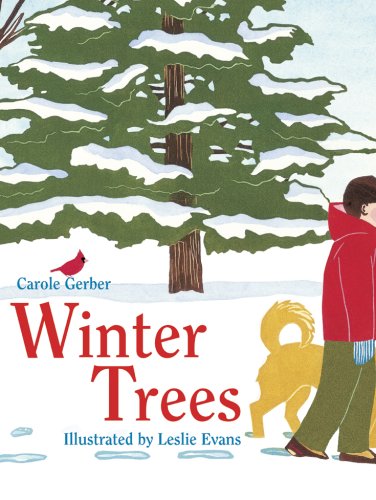
It's not winter, but keep this other award-winning book about trees in mind for next fall as the leaves begin to drop: Winter Trees by Carole Gerber (2008). We often consider tree identification through leaves and on what trees look like in the summer and fall seasons, full of green leaves or the hues of yellow and red as the days become shorter. This book is unique in its portrayal of the branching structures only observed in the winter when trees are without their leaves (although evergreens are also portrayed). Written in prose with limited text, this read-aloud book contains just enough information to convey the structural differences among oaks, beeches, and other types of trees. The illustrations by Leslie Evans are realistic enough for noting those differences, though not as detailed as those presented in books by Sill (such as About Habitats).

Friday, April 12, 2013

Keep an eye out for Sylvan Dell

We had the opportunity today to sit and chat with with Darcy Pattison and Terry Jennings, two  award winning authors who write for Sylvan Dell publishers. Their enthusiasm and excitement about their books, Desert Baths (Darcy) and Gopher to the Rescue! A Volcano Recovery Story (Terry) reminded us of why we keep coming back to see Lee & Donna German, who started the publishing company, every chance we get.

We first met the folks from Sylvan Dell at the 2008 NSTA Convention in Boston, when their books The Rainforest Grew All Around, ABC Safari (both of which are perfect for the tough K-1 crowd), and Ocean Seasons (for the older 3rd -5th crowd) caught our eye. Over the past five years, we've seen their collection of offerings grow to over 80 books focusing mostly on science (and math & and geography) concepts for elementary age learners. Many of their books have won awards...including some International Reading Association/Children's Book Council's Teachers Choice Awards & some NSTA Outstanding Trade Book Awards--two of our favorite "lists" for good books! They also quite impressively rely on a cadre of scientists in the field who vet each book, ensuring accuracy. These are books teachers can use knowing the information is correct.


However, Sylvan Dell offers unique opportunities to push the reading experience beyond the pages of the book with some of the more unique aspects of their publications.Teachers will likely be impressed with the "For Creative Minds" sections included at the back of each book. (Follow this link to see the Creative Minds pages for Ocean Seasons!) These pages include a variety of ways to extend the concepts explored in the book in cross-curricular ways, often including more detailed information, related maps and charts, fun little quizzes, and even experiments. But...

...one of the most exciting parts of the Sylvan Dell way of doing things has to be their online supplemental resources. Each book has its own homepage with an array of "extras" that include .pdf previews of each book, teaching guides, quizzes, related websites, and even interviews with the author. They also have a searchable standards database that links books with individual state standards or vice versa. And, just in case that wasn't appealing enough, Sylvan Dell offers eBook options in both English or Spanish (text AND audio!). They even offer some free trials and actually have pretty good deals for school site licenses.

If you ever get to NSTA or IRA or any of trade shows Sylvan Dell attends, keep an eye out for them and be sure to stop by the booth and introduce yourself to Lee and Donna (or any of their friendly employees!). But even if you don't get out much, you can spend a few hours exploring their books and resources on the website. Enjoy!