Wednesday, April 30, 2014

Behold the lowly tapir

Behold the lowly South American tapir. I only knew of it through my girls' (now in high school) alphabet card matching game of mothers and babies. A was for Anteater, B was for Bear...T was for Tapir, which I unknowingly pronounced as "tap--eer" all those years. It's actually "tape-ear." But then again, I say "draw" for drawer (it's a northern thing) and my Texan husband uses "pin" for both the sewing item and writing implement. He also uses "next week" for this week, but I digress. 

The tapir is the subject of an amazing scientist-in-action book called The tapir scientist: Saving South America's largest mammal by Sy Montgomery, with pictures by noted photographer Nic Bishop. Even the title of this book packs a punch:  you know the tapir is in danger, you know where it lives, you know something about its size, and you know what kind of animal it is. The title alone is a lesson in concise communication! As noted in the first chapter, fossils of the first tapirs are from about 12 million years ago during the Miocene era. Despite this long history, tapirs are little known. This animal needs a publicist, and Montgomery is the perfect person to raise awareness of this interesting mammal. 

This NSTA/CBC Outstanding Science Trade Book published in 2013 chronicles the work of Pati Medici and her team of field scientists as they track, observe, and monitor these clandestine creatures. Medici's work is not for the faint of heart or those who prefer hotels to camping (like myself): mosquitoes and ticks abound, pumas surround, sleep is minimal. I can hardly shoo kids out the door without morning coffee, so mustering early morning energy to gather scat - and being excited about it - is something I can only admire from afar. Several vignettes are also included, such as profiles of other team members and information about how scientific research is conducted. For example, "Pati's Spreadsheets" provides an explanation of how data collected in the field is analyzed. Nic Bishop's photos add to the high interest level of this book; whether he's capturing tapirs at night with infrared cameras or shooting up-close photos of gloved hands picking ticks off the tapir's back, Bishop's images bring this story to life. 

To accompany the print portion of Medici's field work, there are videos available from the Scientists in the Field website.  These would be great resources to share with students in addition to reading aloud portions of the text - for example, you can listen to an interview with Montgomery about her research for this book. The tapir is hardly the rockstar of the animal world, but this book will engage you with its fascinating story. 

Saturday, April 5, 2014

Enjoying Authors & Illustrators at NSTA

We are spending an hour this morning with Sarah Campbell, Melissa Stewart, and Shannen Bersani!

Sarah is the author of Wolfsnail and Growing Patterns, books we have shared on our blog before...but she also has a new book, Mysterious Patterns, about fractals! 
Melissa is the author of many books we have featured in the past, but this year she has two more books on the Outstanding Science Trade Book list: No Monkeys, No Chocolate and A Place for Turtles. 

Finally, the folks at Arbordale Publishing (formerly Sylvan Dell--check out some of our early posts) came to the session as well. Publisher Donna German (left) and illustrator Shannen (right) talked about the research that goes into creating pictures that support the text. (Shannen's research for visuals has even led to discovery of textual misinformation--what a great symbiotic relationship!)

It has been a fabulous morning indeed! 

Wednesday, March 19, 2014

Calling All Engineers (Girls, especially!)


It is always a challenge to find science picture books focused on physical science concepts, so you can imagine my excitement when I wandered into our local bookstore with a dear friend and happened upon Rosie Revere, Engineer, by Andrea Beaty. I almost gave a little shriek of excitement as I pulled it off the shelf and started reading.


While the book doesn't really address concepts associated with physical science, it clearly both addresses the fear (and inevitability) of failure and breaks down the gender based biases associated with engineering in the context of a not-over-the-top fictional story. In fact, Beaty pays homage to Rosie the Riveter, who is, of course, the great Aunt of the main character...and the one who urges young Rosie to live out her designing dreams.


While I will admit being a little disappointed that the one-paragraph author's note was buried on the last page amidst the dedication and copyright information.  It does, however, provide a bit of information about the role of women in WWII. Also of interest is a 2-page spread containing sketches of important events in women's aviation history--and the "machines" that accompanied each (first woman to fly in a hot air balloon, first woman to design airplanes, first woman to pilot a Boeing 747...). 


This seems like the perfect book for creative young minds--and girls in particular. And, if you have a young female engineer, the book could be a perfect companion for a new award-winning "toy" designed to get more girls involved in the STEM fields-- GoldieBlox. Both are worth a look!


Monday, January 27, 2014

Beyond a shadow of a doubt, I'd like a spring forecast

This polar vortex phenomenon is getting a little old. The week ahead here in Knoxville includes below-freezing temperatures and some six-sided precipitation. However, we're in luck, possibly: February 2nd is approaching, the day when the world (or at least the US) eagerly awaits the long-term forecast by that cute meteorologist, Punxsutawney Phil. He even has his own website now, complete with some teacher resources (not much in the way of science, though). Having graduated from the University of Dallas where Groundhog Day is fanatically celebrated by students and alumni across the country, I can hardly wait to make a toast to Phil and cheer for the weather forecast he'll provide at 7:25 am on Sunday, especially if he does not see his shadow.

If you are looking for some resources to prepare for Groundhog Day, here are some ideas. A narrative non-fiction resource is Gail Gibbon's 2007 book Groundhog Day! In addition to the historical background about Groundhog Day, Gibbons' book also includes information about the physical attributes and burrow formations of groundhogs. The final page of this primary level book is entitled "Digging up groundhog facts"and contains additional interesting information. Cartoonish drawings of humans are coupled with some more realistic depictions of groundhogs, though still with an impressionistic aspect. You can download a teacher resource book for Gail Gibbons' books here.

Another choice for sharing the fun and science of groundhogs and weather predictions is Groundhog Weather School by Joan Holub. You might recognize her name from our blog post about cloud books - she is one of the authors of The Man Who Named the Clouds. If you have an older version of this book, the cover will be different - it was reprinted in 2013.  This book has a mix of story elements and factual information, making it both entertaining and informative. I am not usually an advocate of books with talking animals, but in this case, there are enough non-fiction aspects to make it worth including in a science/literacy lesson. A checklist of characteristics (such as mammal, live in burrow, rodent, herbivore) determines who gets into Groundhog Weather School, and other organisms which exhibit weather-related behavior such as honey bees and cows are described. Brief depictions of famous scientists associated with weather (such as Luke Howard  and Snowflake Bentley) are profiled. Due to the cartoon-style bubbles of text from the characters, this may be better as an independent read as opposed to a read-aloud, though you could certainly channel your inner Hollywood star to read in different voices. The final page includes historical information about Groundhog Day and a labeled drawing of a groundhog.

For science activities related to measuring shadows, you can find ideas from Scholastic  and Exploratorium. For a long-term project, consider having students measure their shadows once a week in the same spot around the same time from now until the end of the school year. They can graph the data to infer what causes the differences in the weekly measurements.

Whether you spend February 2nd watching Bill Murray in Groundhog Day, watching the Super Bowl or Puppy Bowl, or celebrating Groundhog Day with friends, we hope you enjoy this weather-based holiday!

Tuesday, January 21, 2014

What a Winter!

Clearly, the end of 2013 was a busy one for Kristin and me, and this blog took a back seat to the other 3,427 things we had to get done. But we're well into 2014, and we're ready to get back to our regular entries!

So far, most of the country has experienced quite a winter. Meteorological terms like "polar vortex" have been the topic of conversation (Go, Al Roker!), and another big snowstorm is hitting the East Coast. Temperatures have been dropping here in Knoxville all day, and earlier in the day I got stuck in a downpour consisting of what appeared to be tiny snowballs (no flakes!) that stuck to everything (including hair) and took their own sweet time to melt. With that experience fresh on my mind, I headed to my bookshelf to pull out some "snow" books--to see how those crystals might have formed (I think they might have been classified as "lump graupel" according to Magono & Lee's snow crystal classification system). And while I was at it, I grabbed a few others that might be appropriate for the coming chilly week.


The first is appropriately titled, The Story of Snow: The Science of Winter's Wonder, by Mark Cassino. It has multiple layers of text, diagrams, and photographs, making it engaging for a wide range of readers and grade levels. The scientific vocabulary included isn't overwhelming because the explanations are straightforward, and the diagrams help to provide context--especially in terms of "book" vs. "real life" size comparisons (see below).  Directions for catching your own snowflakes are included, as well. This 2010 Outstanding Science Trade Book Award winner should be a staple in elementary classrooms.

"Snowflake" Bentley and his camera.
The perfect book to accompany The Story of Snow, is the oldie but goodie, Snowflake Bentley, by Jaqueline Briggs. This 15-year-old is now almost a "classic," and is Bentley's story is just as intriguing now as it was in 1998. Teachers now also have access to a great Wilson Bentley website run by the Jericho, VT (his hometown) Historical Society. They have resources that include his biography, photos, articles, book reviews, and even some FAQs. The website makes a nice companion to the book, and Scholastic (or Amazon) now offers some of Bentley's books: Snowflakes in Photographs and Snow Crystals.


Finally,  I was really excited when I ran across this book cross-listed on Amazon, since it seems to be written for a similar elementary crowd by a current "Snowflake Bentley" type! The Secret Life of a Snowflake: An Up-Close Look at the Art and Science of Snowflakes, is full of photos and explanations at just the right level for elementary students. It is written by Dr. Kenneth Libbrecht, a physicist and professor at CalTech. (He grew up in North Dakota, so he knows his snow!), who has his own website full of great teaching resources. This book will be most appreciated by upper elementary (and middle school) students, but the photos (like the one below, comparing snowflake sizes to a penny) look engaging for all ages! This is one I'm going to order so that in the future, it sits side-by-side with the others on my shelf!


Monday, November 11, 2013

Engineering Feats, Above and Below NYC Streets

New York City is famous for many landmarks and events, and this time of year brings one particular event to mind: The Macy's Thanksgiving Day Parade. Yes, Virginia, there was a time when no one even talked about Santa Claus until after the fourth Thursday in November, when he made his triumphant ride down the streets of Manhattan to usher in the official start of the holiday season at the close of the parade. 

Melissa Sweet's 2011 award-winning book Balloons over Broadway: The True Story of the Puppeteer of Macy's Parade provides an insightful history about the larger-than-life helium balloons for which the parade is so famous. Artist-turned-engineer Tony Sarg worked for Macy's department store as a window designer, and helped created puppets for the first Macy's parade in 1924. Realizing that only people up close could see the puppets, he went through various designs until finally imagining a way to let everyone see the displays - by using large balloons filled with helium. The process by which Tony invented these festive balloons is cleverly depicted with cartoon art, cut-paper fonts, and actual photos. Sweet includes an author's note and information about her art at the end, along with a bibliography and sources.  Check out her educator page associated with this book here

Below the streets of Manhattan, around that same time, another engineering marvel was taking place: the building of the New York City subway system. Martin Sandler chronicles the building of this transportation landmark in his 2009 book entitled Secret Subway: The Fascinating Tale of an Amazing Feat of Engineering. Written at an upper elementary/middle school level, this 96-page book encompasses the history, science, and politics associated with the development of an ambitious underground construction project of the late 1800s and early 1900s. The visions of engineers Alfred Beach and William Parsons ultimately resulted in the reduction of congestion and pollution on the streets of Manhattan. Black and white illustrations, photos, and artwork supplement the text. I'll admit that the graphics were a little less than I'd expect from a National Geographic publication, but that aspect aside, the story of such a famous and integral part of New York City is well documented and interesting to read. 

So whether you are watching the parade on TV or traveling there by subway, you can thank engineers for making this annual Thanksgiving event so spectacular! 

Tuesday, October 15, 2013

Carve out time to learn about pumpkins


We’ve been highlighting books on spiders and skeletons, so this post will continue the autumn theme by highlighting a few books about pumpkins. After all, what's a Halloween display without a glowing pumpkin to greet trick-or-treaters? Sure, there's sticky goo that has to be scooped out before etching triangle eyes and a toothy grin, but it beats trying to find an extension cord to plug in a synthetic jack-o-lantern. 

Gail Gibbons provides a classic book for this topic with The pumpkin book. Recognized by the International Reading Association as one of its Teachers' Choices for 2000, this book continues to be a great resource for both scientific and cultural information about pumpkins. The life cycle of the pumpkin is depicted through text as well as cartoon-style (but labeled) drawings. Connections with Halloween and Thanksgiving are included in the narrative, including a drawing of that quintessential carved pumpkin. The final page has short excerpts about historical, scientific, and cultural aspects of pumpkins, as well as directions for drying pumpkin seeds.


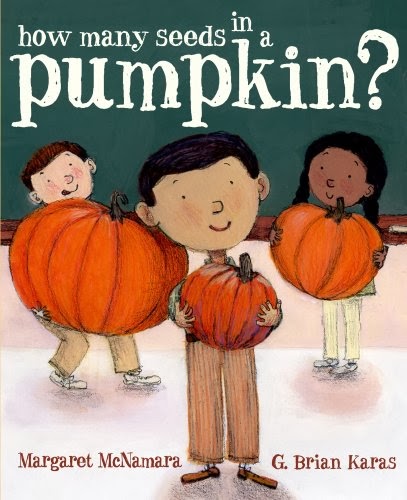
Speaking of seeds, a good read-aloud story about pumpkin seeds is Margaret McNamara’s How many seeds in a pumpkin? This 2007 fictional book, also recognized as a Teachers' Choices selection, tells the story of students in a first grade classroom who are predicting the number of seeds in small, medium, and large pumpkins. The students scoop out the seeds and count them by grouping in twos, fives, and tens, which makes this book a resource for easily integrating math with science. After all the seeds have been counted, the teacher explains some clues that his students can use for predicting the number of seeds, such as the color, species, and number of lines, indicating that it’s not just the size  of the pumpkin alone. Spoiler alert: The smallest pumpkin winds up having the most seeds. “Charlie’s Pumpkin Facts” at the end includes some facts about pumpkins, such as the time needed to progress from seed to fruit.

Finally, Pick, pull, snap! Where once a flower bloomed by Lola M. Shaeffer (2003) is a lift-a-flap book that overtly makes the connection between flowers and fruit. The writing style of this book is vivid and succinct, resulting in its recognition by the National Council of Teachers of English as a Notable Children's Book in the Language Arts. Each page spread has three to five richly descriptive sentences about one type of flower (“On a sandy hill, yellow blossoms open on knee-high plants, spilling soft pollen between petals”). The subsequent fruit is shown under the flap, like a mystery unveiled, and the text for each identified fruit ends with “… where a flower once bloomed.” Up-close paintings accurately portray the seeds and flowers, and children are depicted picking each resulting fruit: pea pods, raspberries, corn, peaches, peanuts, and pumpkins. The end pages include additional information about each fruit shown in the book as well as factual information about plant pollination and fertilization. A glossary includes words that are in the text of the book, such as “pollen,” and words that are in the end pages about plant fertilization, such as “anther” and “stamen.”

These are just some of the resources available for finding out about the life cycle of the pumpkin. Knowing about their life cycles may help you appreciate those slimy seeds and strings when you are carving! I'll have one carved with triangle eyes, but if you are the Martha Stewart type and want something more creative, you can check out her templates here.  

Monday, September 30, 2013

'Tis the Season for Skeletons

At my daughter's request, this was the weekend of getting the pumpkins, spiders, ghosts, and skeletons out of the plastic crates where they reside and scattering them around the house Her favorite is always the peel-and-stick glow-in-the-dark skeleton that typically spends the  month of October in the middle of our powder room mirror. (Yes--it takes maneuvering to actually use the mirror, but all three kids say, "We have to put the skeleton there...It's tradition!") The combination of the skeleton staring me in the face every time I wash my hands and the release of Cut to the Bone, the newest book written by UT's renowned forensic anthropologist, Dr. Bill Bass, and his writing partner, Jon Jefferson (I got my signed copy Saturday!) made me decide skeletons & bones would be the topic of choice for this week's blog. 

One of our favorite skeleton books is, You Can't See Your Bones with Binoculars, by Harriet Ziefert. Each page (or 2-page spread) is headed by a slightly-adapted line from the African American spiritual Dry Bones ("The foot bones are connected to the toe bones..." and the playful illustrations integrate actual x-rays as a means of showing the bones in their proper place and form. The text contains information about key bones, including their general ("shoulder") and more technical ("clavicle" and "scapula") terms, in addition to a description of their purpose ("...the main task of the backbone is to protect your spinal cord.") or how they function ("The 'ball' at the top of another bone called the humerus rotates so that you can move your arm in all directions!). Most two page spreads also contain an interesting fact or two related to the bone being discussed--like people who wear knee pads since kneecaps don't have much padding. The book draws to a close with a solid page of information about broken bones and a drawing of a skeleton with all the previously mentioned bones clearly labeled. This book makes a perfect read-aloud for 2nd grade and up, but 4th and 5th graders will also enjoy reading this non-fiction text independently.

Bob Barner has another skeleton book, straightforwardly called Dem Bones. It, too, includes a line from the traditional song on each page, supported by a short, 3-4 sentence paragraph with details about the identified bone. For example, on the "leg bone" page, Barner delineates that the leg bone is actually two bones and the location of each, along with a note that it is the tibia that hurts if you get kicked in the shin! These big bold illustrations are actually of whimsical skeletons and not as clearly marked as those in Zeifert's book. However, this one too, closes with a labeled skeleton, and the more compact nature of the text makes it  more appropriate for a K-1 read aloud, and the less technical language makes it a more independent read for those in 2nd grade and up. (And, there is a YouTube video reading of this book done by some college students that could be used in a listening center!)

October is the perfect time to use easy access to skeletons of all sorts to your students' learning advantage! If you really want to help them learn the bone-associated vocabulary, make it interactive. Buy a cardboard skeleton, and use adhesive Velcro dots to attach labels. The kids should be able to pull all the labels off and then show what they know!

Tuesday, September 17, 2013

Conquering Arachnophobia


Spiders, members of the arachnid class, can evoke both awe and fear. There is a reason that movies such as Arachnophobia are created – people relate to that fear of spiders. Had the producer tried to pitch Lepidoptera phobia (fear of butterflies and moths), I doubt it would have gone very far. The closest I can think of is Mothra, the low-budget sci-fi movie from 1961featuring a giant moth. 

For the past week, an industrious spider has maintained an elaborate orb web right outside our front door. My son first noticed it one morning as the web seemed to be floating in midair, easily visible with droplets of dew. As expected, he had a mixed reaction to seeing the spider - he did not want to get to close to it, but watched in amazement as it gingerly walked up and down the web. Seeing it outside was certainly preferable to finding one in the bathtub, which has also occurred recently.  Some studies suggest that you are never more than ten feet away from one, so whether you want to see spiders or want to avoid them, they are always nearby! Maybe that reminds you of some of your neighbors. 


 If you want to know more about spiders to demystify them, here are two suggestions. For intermediate students, Sandra Markle’s Sneaky, spinning baby spiders (2008) vividly depicts many aspects of these incredible arthropods. This book has been recognized as an NSTA/CBC Outstanding Science Trade Book and has earned other awards as well. Segments entitled “Starting life in an egg” and “Mom on guard” describe the life cycle of spiders, supported by large, up-close photos of various species. The end pages include a habitat map for each spider species depicted in the text, a “Be nice to spiders” segment that provides an overview of their importance in the ecosystem, and a combined glossary/index. Markle also includes a brief endnote about her inspiration for writing the book.


For younger students, it’s certainly easy to find books about the butterfly’s life cycle. Perhaps that’s because of its interesting stages and beautiful adult species. While many of us are familiar with Charlotte’s egg sack gallantly protected by Wilbur in E.B. White's Charlotte's web, there are limited options for informational texts about arachnid life cycles. One choice is Up, up, and away by Ginger Wadsworth (2009).  Also recognized by NSTA/CBC as an Outstanding Science Trade Book, this book depicts a spider’s life cycle with simple text appropriate for primary students. The life cycle of a spider is described through the four seasons, beginning with a spider forming an egg sack in the fall. Predatory/prey relationships are incorporated as the spiders encounter lizards, snakes, and birds. The illustrations are more accurate than cartoon depictions, but are not quite technical reproductions. An endnote entitled "The spin on garden spiders" describes the species from the book (Argiope aurantia) in greater detail. 
 

As a final note, you can participate in a citizen scientist documentation of wildlife in your area, including spiders, through Project Noah. Supported by National Geographic, this site contains photographs of local organisms taken by students and others who are interested in documenting plants and animals in their environment.  Strategies to help teachers incorporate science investigations in schoolyards and backyards can be found under the Education link. 

The more students know about spiders, the more likely they will be to recognize their importance in the ecosystem. As stated so beautifully by Marie Curie: "Nothing in life is to be feared, it is only to be understood. Now is the time to understand more, so that we may fear less."  

Wednesday, September 4, 2013

Chickens and Eggs

Last week (or a little longer), one of our readers asked for any books that might accompany the installation of a school chicken coop, so we've been doing a little digging. We haven't found a whole lot of what we would call high-quality picture books for kids that relate specifically to raising chickens, but chickens and eggs in general...well, we do have some suggestions for addressing those topics.

In the "Oldies but Goodies" category, we want to highlight two books in particular: Ruth Heller's Chickens Aren't the Only Ones and Chicken an Egg, by Christine Back & Jens Olesen. I'm going to date myself a bit by saying that I used both of these in my own 2nd grade classroom each spring when we studied oviparous animals ...and hatched chickens with the support of our local agricultural  extension (who provided the incubators and eggs!).

My favorite for showing the development of a chicken was Chicken and Egg, with its full-color photographs and two layers of text. It appears to be out of print, but  is available in paperback through a number of venues (including Amazon, linked above). Chicks & Chickens, by Gail Gibbons and From Egg to Chicken, by Anita Ganeri are newer (2005 & 2006, respectively) and also offer insights on chicken development. These two  include a great deal of extra information on chickens in general. Chicks & Chickens addresses their physical characteristics and behavior in addition to their life cycle and egg development. In this book, Gibbons follows her typical style of including a lot of information supported by detailed illustrations in bold colors that tend to extend the text though the use of diagrams. From Egg to Chicken is a more traditional non-narrative informational text, including a table of contents, bolded key words, a glossary, suggested resources, and even an index. It would engage kids through the vivid photographs of chickens and the accompanying captions. Both Chicken and Egg and Egg to Chicken could be used with younger students, and while the book by Gibbons could be read aloud to just about anyone, the text is probably most appropriate for 3rd graders. 


Chickens Aren't the Only Ones appears to remain a popular despite its age. It, however, goes beyond chickens to mention all sorts of animals that lay eggs. Birds, reptiles, amphibians, and fish...snails, spiders, and all sorts of insects are addressed, though not in any detail, making it a great introduction to the concept of oviparous animals. Another great addition to a lesson on egg-layers is a 2007 NSTA Oustanding Science Trade Book winner, Guess What is Growing Inside this Egg, by Mia Posada. This book is illustrated so that the reader gets clues (in verse) about the kind of animal growing in the egg, and when the page is turned, the full illustration reveals the animal, accompanied by a detailed description (not in verse) about the newly hatched animal. An Egg is Quiet, by Dianna Aston would be a great companion book to use with Guess What's Growing Inside this Egg, though Aston's book focuses just on the eggs themselves. The only tricky part of An Egg is Quiet is that its primary layer of text is written in cursive, making it tough for kids to read independently. However, the illustrations are all labeled in more typical printed text, and so a lot of information can be gleaned without paying attention to the lines written in script. Aston compares the shape, size, colors, texture, and markings of eggs, and takes a page or two to highlight the in-egg development of chickens, salmon, and grasshoppers. Sylvia Long's stunning illustrations make this book a work of art as well as a means of obtaining both textual and visual information.


Finally, I couldn't let the chicken and egg topic go without mentioning One Hen: How one Small Loan Made a Big Difference, by Katie Smith Milway. This book is geared a little more toward social studies in general and economics in particular. But, it tells the story of Kojo, a youngster living in the Ashanti region of Ghana, in Africa, and how he uses a few coins to buy a hen...and then sells the extra eggs at market...and then buys more hens...and then a farm (after he goes to school of course!)...and eventually chages the lives of his family, community, and town. Best of all, it's based on the true story of Kwabena Darko; check out this related video on YouTube!